Friday, 12 October 2012

North Goa, full of sun, sea and good food


Our Goa tour started from North Goa.

  On reaching Panaji we crossed the Mondovi river and drove staright to Calangute. The distance from Panaji to Calangute is almost 15 kms and the road condition is also good. Also driving to any beach in North Goa is relatively easy as you have direction markers everywhere on the road and also
people are very friendly and helpful.

  We reached Calangute around 3:30 PM. The road near the beach is bubbling with tourists and various shops that sell everything from fancy beach wear, beach accessories like sunglasses, hats and all.... to goan handicrafts, readymade seafood(yummy), tattoo shops and lots more. The road is also crowded with tourist buses and cars.There are plenty of budget hotels and homestays in Calangute.

  Since we did not book any hotel in advance so we first went for hotel searching. The best hotel in Calangute is undoubtedly Calangute Residency owned by GTDC. It is located nearest to the beach and from the cottages you can have a slice of the sea anytime. Though it was not the season but still there were no rooms available in that hotel. The hotel manager directed us to another hotel, very near to Calangute Residency, also owned by GTDC. It was Calangute Residency(annex). This time we were lucky. There was only one room available and that too only for that day. Since we had planned to stay in Calangute for one night, this was okay for us.The room charge was Rs 1040 per night in off season (I hope I remember correctly)

  It is good to know that the checkout time in hotels across Calangute is 10 AM. Only for hotels owned by GTDC the checkout time is 12 noon. 

  After getting some rest in the hotel we went to the beach. The beach is very popular among tourists and so is a little crowded even during off season. The beach has life guards like most beaches in Goa and if you walk along the beach for some 1 kilometres you will reach Baga beach which is a much less crowded beach.
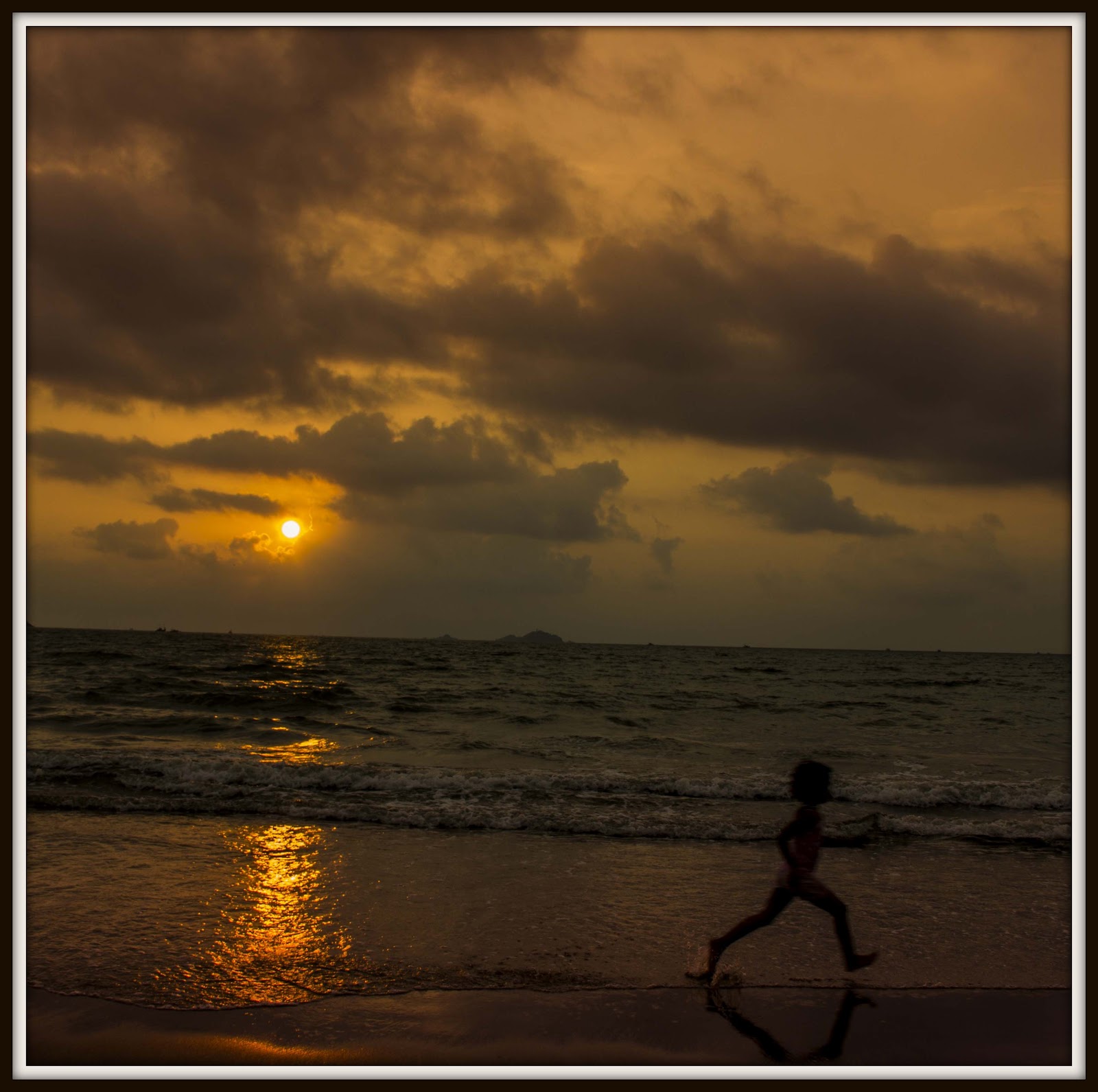

Calangute beach. Sunset.
  We saw people roaming around in Goa in rented bikes and cars. Bikes can be rented for as little as Rs 200 a day (depend on your bargin) but the person taking the rent must have a valid driving licence. In Calangute sea food is damn cheap and tasty. The food prepared in the small roadside shops are tasty and very easy on the pockets. We enjoyed a medium sized pomfret fry for as little as Rs 80 and the food quality was really good. The roadside shops sells various seafish, crab, prawn, chicken fries.

  In Calangute, there is a 200% chance that you encounter people trying to lure you with attractive offers like free resort stays, complimentary dinner etc. By luring with the offers they will later try to sell time shares and we would definitely recommend not to fall into their trap. Its always better to ignore them from the very beginning.

  The first half of the next day was reserved for seeing the other major beaches in North Goa namely Anjuna and Vagator. We started pretty early; at around 7 am.

  Anjuna beach is some roughly 9 kilometres from Calangute and to reach there you have to go through Anjuna village. There are plenty of homestays near Anjuna beach. Anjuna is a beautiful red rocky beach. The beach is made of big red colour stones and coconut trees line the entire beachline. Though very beautiful, it is not a beach for sea bathing or strolling.


Anjuna Beach


Anjuna Beach

Texure of the rocks in Anjuna Beach.

Anjuna Beach

  From Anjuna we went to Vagator beach which is very nearby, approximately 4 to 5 kilometres. This beach has yellow sand and black rocks. There are also many water sport facilities available.


Vagator Beach

Vagator Beach

Vagator Beach

Vagator Beach


  From Vagator we went to see the Aguada Fort. For that we had to come back to Calangute and from there take the road that leads to Aguada Fort. Anjuna/Vagator beach and Aguada Fort are on either sides of Calangute. Fort Aguada was a Portuguese fort and is now protected by the Archaeological Society of India. A nice view of the Arabian sea can be obtained from here.
Next to Aguada fort is a lighthouse which can also be visited. The Sinquerim Beach is also located near to Aguada Fort. It is an upcoming beach.


Aguada fort. Entrance.

Aguada fort. Stairway.

Description written on the top of the fort.

Aguada fort. Top.

Agauda fort. Top.

Entrance to light house at Aguada fort.

View of the sea from the top of Aguada fort.
  It was almost 10 am when we reached our hotel. The check out time was 12 noon so we hurriedly packed our bags and went for a heavy breakfast.
We booked two advance tickets for the sunset cruise on river Mondovi from the hotel reception. The price for each ticket is Rs 150 but for guests staying at any GTDC hotel the price is Rs 100.

  We bid adieu to Calangute and proceeeded towards Old Goa. Our next mission will be to see the churches in Old Goa.

Sunday, 7 October 2012

Churches in Goa


A visit to old Goa is never complete without seeing its beautiful churches and chapels.
We spent a little less than one full day in exploring the churches -a full second half of a saturday and first half of the next sunday.
  
  The churches are mostly built by the Portuguese in the 16th century. The churches are mostly built of laterite stone, however basalt was used for pilasters and columns for decorative purposes.

  On Saturday we visted Se Cathedral, Basilica of Bom Jesus, Chapel of St Catherine and Church and convent of St Francis of Assisi. All these churches and chapels are just close to one another and can be covered on foot. There is also a museum adjacent to the Church and convent of St Francis of Assisi and the entry fee is Rs 10 per person. Photography is not allowed inside the museum.

  As you enter this compound you will be approached by local hawkers selling garland and candles though they are not very persuasive.


Map you can use to navigate the churches in old Goa
  Since we stayed at Panaji, near the Goa Secretariat, it took us 20 minutes to reach there by driving.The churches are kept open for public on all days from 8:30 AM to 5 PM. Entry is free except for the museums and art gallery. Photography is also allowed inside the churches provided you don't disturb the peace inside the church and also don't take photos of people.

  Se Cathedral and Basilica of Bom Jesus are situated on either side of the main road and both are declared as world heritage site by UNESCO. The Basilica of Bom Jesus is the most famous of all the church  in Old Goa. It contains the relics of St. Francis Xavier, the patron saint of Goa. It was the first church in India to be elevated to the status of a minor basilica in 1946. There is also an art gallery towards the exit of the Basilica of Bom Jesus.


Basillica of Bom Jesus
Main alter inside Bom Jesus Basillica
  After seeing Basilica of Bom Jesus we went to Se Cathedral. It is one of the most beautiful church ever seen by us. We were also very lucky to see a couple in their wedding finery who had come to the church with their family and friends to solemnise their marriage.
 
Jesus,SE Cathedral

SE Cathedral

Inside SE Cathedral
  Then we went to the church of St Francis of Assisi.This church is much much less crowded compared to the other two. The church has beautiful large wood panels of oil paintings, depicting the life of St Francis of Assisi, placed on the walls on either side of the main altar. The convent is housing the Archaeological museum and entry charge is Rs 10 per person.


Church of St. Francis Assisi


Inside the church of St. Francis of Assisi

Pictures on the wall inside the church of St. Francis of Assisi

Pictures on the wall inside the church of St. Francis of Assisi
   West to St Francis of Assisi is the Chapel of St Catherine. It is a magnificently built church dedicated to St Catherine and mostly made of laterite. The chapel has a small garden in front of it.


Chapel of St. Catherine
  It took us almost four hours to see these churches and chapels on Saturday. We were terribly hungry when we reached our hotel and so we decided to go to the restaurant first that was on the first floor of our hotel. It was an open air restaurant and we enjoyed our 
high snack while seeing the sunset and the cruise boats on the river Mondovi.

  We decided to see the remaining churches on the next day. Our to-see list included St. Augustine Church, Church and Convent of Santa Monica, Church of our Lady of Rosary, Church of St. Cajetan, Arch of Viceroy and Panaji Church.

  We drove straight towards St. Augustine Church which is very close to Basilica of Bom Jesus. The church is basically in ruins and has practically turned into an excavation site for the Archaeological Survey of India.There are placards in the courtyard of the church that elaborate about the history and the reasons for its destruction. The Church, when intact, was perhaps the biggest in Goa and that can still be understood from its vastness. There are still a few tiles left on the interior walls of the church.

St. Augustine Church
  We saw Church and Convent of Santa Monica from outside. Next to Santa Monica is the Museum of Christian Arts but unfortunately it was closed on Sunday. A few meters from there is the Church of our Lady of Rosary. This is the oldest surviving church in Goa.


Church and Convent of Santa Monica
Mother Mary in front of Santa Monica. You can also spot St. Augustine Church in the back.

Church of Our Lady of Rosary
  We then headed towards Church of St. Cajetan. It is a beautiful church built along the lines of the Basilica of St. Peter's in Rome. Although the church is dedicated to Our Lady of Divine Providence, it has been name after St. Cajetan, the founder of the Order of Theatines. The Church of St. Cajetan is the only surviving domed church in Goa.


Church of St. Cajetan

Inside the church of St. Cajetan
  From Church of St. Cajetan the Arch of Viceroy is hardly one hundred meters.
It was built by Francisco da Gama, the great grand son of Vasco da Gama, who was the governor of Goa from 1597 to 1600. It was built as a memorial to the achievements of Vasco da Gama, the famous explorer. 

Arch of Viceroy
  The last church left for us to see was Panaji Church. The original name for the church is Church of Our Lady of the Immaculate Conception. Locals call it by the name Panaji Church. We drove back to Panaji but we  could only see the church from outside.


Panaji Church
  It was time to head for Colva, our next stop in South Goa.